Exact AI: When Approximate Answers Aren’t Good Enough
In Episode 12 of Tech Command Investing, I speak with Johannes Waldstein, Co-Founder & Chief Executive Officer (CEO) of PiLogic, to explore a different approach to artificial intelligence (AI): mathematically precise, expert-guided intelligence designed for situations where approximate answers and hallucinations simply aren't good enough.
As investment in AI continues to focus on larger models, more data, and greater computing power, PiLogic is taking a different path.
Its models are designed to reason precisely, operate in milliseconds, and run at the edge, including environments where computing resources are extremely limited and where the consequences of a wrong decision can be significant.
🎧 Listen now:
| Amazon Music | Spotify | Apple Podcasts | YouTube | Audible |
The distinction matters most when AI is being applied to systems that cannot afford to simply be "probably right."
A spacecraft, defence platform, aircraft, or other mission-critical system may generate vast amounts of sensor information while operating in environments where signals are noisy, incomplete, or conflicting. In these situations, an AI system needs to do more than identify a plausible answer. It needs to reason about what is actually happening.
PiLogic's approach is built around this principle.
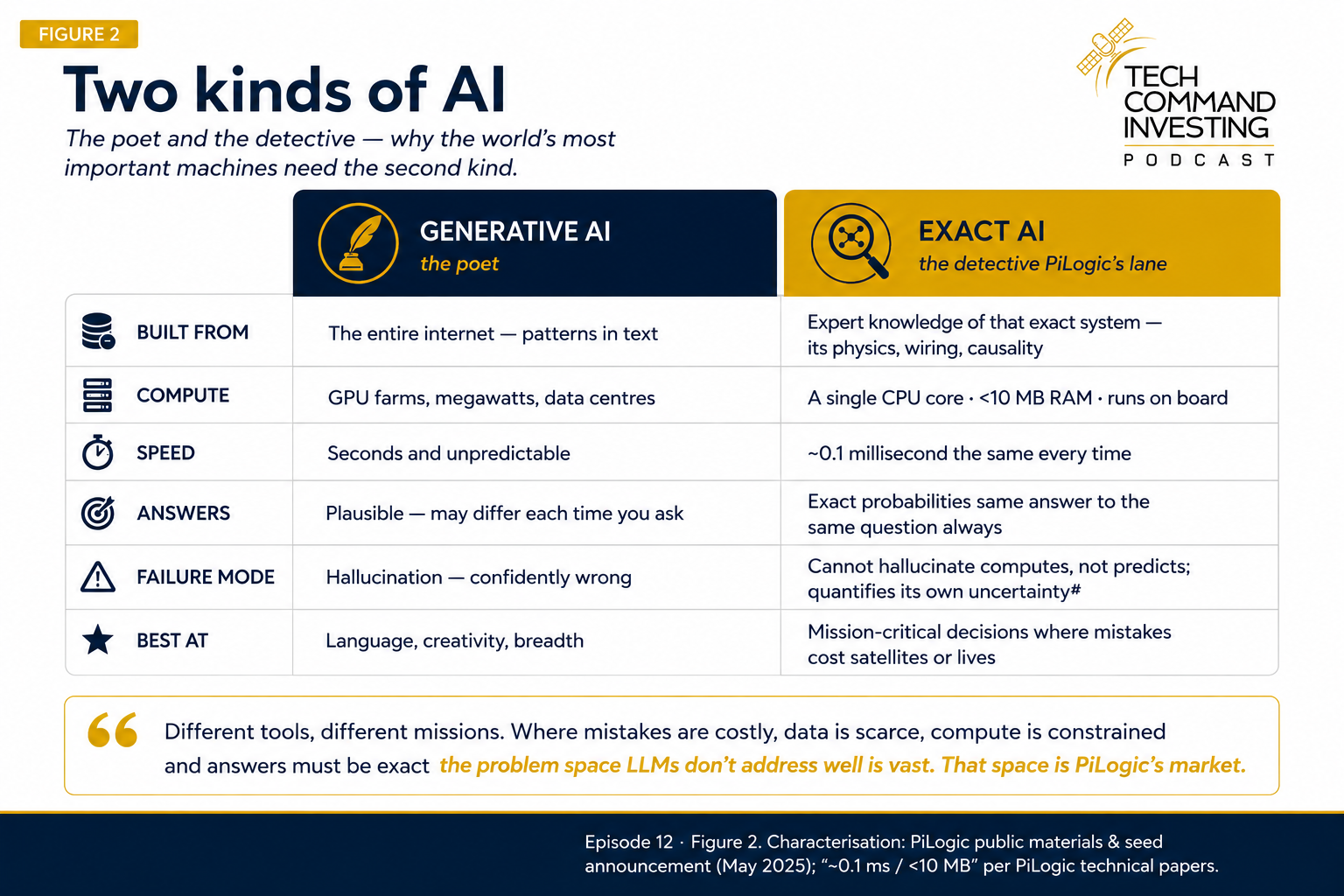
Rather than relying on a general-purpose model to predict the most likely response, PiLogic combines expert knowledge, mathematical models, and probabilistic reasoning to understand the underlying behaviour of a system.
The accompanying carousel illustrates this distinction by contrasting generative AI with PiLogic's approach to exact AI. While generative models are designed to produce plausible answers from patterns in large datasets, PiLogic's models are designed to compute probabilities and reason about the physical system itself.
Reasoning when sensors cannot be trusted
One of the central challenges discussed in the episode is uncertainty.
Sensors do not always provide clean or reliable information. Individual readings can fluctuate, conflict with one another, or be affected by interference. Traditional rules and thresholds can struggle in these situations because a single reading may trigger an incorrect conclusion.
PiLogic uses Bayesian inference to approach the problem differently.
By combining multiple pieces of evidence, the system can continuously update its understanding of what is happening. Instead of treating each sensor reading in isolation, it reasons across the wider system to determine which explanation best fits the available evidence.
The carousel illustrates this through a simple detective analogy before applying the same mathematical principle to a satellite system: as new clues arrive, the probability of different explanations changes.
This becomes particularly important when a system experiences a fault.
Rather than simply flagging an anomaly, PiLogic's approach can identify a likely cause and provide an actionable response. In the example presented in the carousel, the system moves from detecting an abnormality to identifying a probable component failure and recommending a sequence of actions.
That difference from detection to diagnosis and action is central to the value of exact AI.
AI at the edge
Perhaps one of the most striking points from the episode is the size of the models.
While much of the current AI landscape is built around increasingly large models and substantial computing infrastructure, PiLogic's models can be measured in kilobytes rather than gigabytes.
This dramatically changes where AI can operate.
Models that require only extremely limited computing resources can run directly on constrained hardware, reducing dependence on remote processing and allowing intelligence to operate closer to the system being monitored.
For spacecraft and other edge environments, this can be particularly valuable. Communications can be limited, latency can matter, and sending every piece of raw sensor data back to Earth may not be practical.
The ability to reason locally, in milliseconds, can therefore become a mission capability rather than simply a software feature.
From satellite health to contested environments
The implications extend beyond spacecraft health.
The same principles can be applied wherever systems need to make sense of noisy or incomplete information. This includes environments affected by interference and Global Positioning System (GPS) jamming, where conventional tracking approaches can become less reliable.
The Episode 12 carousel highlights this through a comparison between traditional Kalman filtering and PiLogic's exact inference approach. The focus is not simply on receiving more sensor data, but on extracting more reliable information from the data that is already available.
This creates a potential software-defined improvement to existing systems: rather than replacing every sensor, an intelligence layer can improve how those sensors are interpreted.
From a vertical use case to an intelligence layer
The opportunity also extends beyond space and defence.
The broader infrastructure potential of this approach comes from applying the same underlying intelligence to different sectors where spectral information and precise identification matter. The carousel points to applications including defence and chemical, biological, radiological, and nuclear (CBRN) detection, environmental monitoring, water management, industrial quality control, gemstone authentication, and food and beverage supply chains.
This illustrates an important characteristic of deep-tech platforms: a technology developed to solve one difficult problem can become infrastructure for multiple markets when the underlying capability is broadly applicable.
The more systems that use the intelligence layer, the greater the potential for the technology to become embedded in operational workflows rather than remaining a standalone application.
For investors, this creates an interesting contrast with the prevailing AI narrative.
The next generation of AI will not necessarily be defined by ever-larger models. In some of the most demanding environments, the winning technology may instead be the one that is smaller, faster, explainable, and purpose-built for the problem at hand.
Key Takeaways
Exact AI for high-stakes environments
Mission-critical systems require intelligence that can reason from system behaviour and underlying physics rather than simply generate plausible answers.
Reasoning under uncertainty
Bayesian inference allows PiLogic to combine evidence from multiple sensors and continuously update its understanding when data is noisy, incomplete, or conflicting.
From detection to diagnosis
Rather than simply flagging an anomaly, exact reasoning can identify probable causes and support an actionable response.
Kilobytes, not gigabytes
PiLogic's lightweight models are designed to operate with extremely limited computing resources, making them suitable for edge environments such as spacecraft.
Resilience in contested environments
Improved inference can help systems maintain more reliable tracking and decision-making when sensors are degraded or affected by Global Positioning System (GPS) jamming.
A different AI paradigm
The future of AI may not simply be about bigger models and more compute, but about matching the right form of intelligence to the consequences and constraints of each problem.
The central question raised by Episode 12 is not whether AI can produce an answer.
It is whether AI can produce the right answer, explain why, and do so fast enough to matter.
For a social-media post or a creative application, an approximate answer may be acceptable. For a satellite, aircraft, or defence system, it may not be.
PiLogic's approach demonstrates another direction for artificial intelligence: smaller models, precise mathematics, expert knowledge, and reasoning designed for environments where uncertainty is unavoidable but unreliable answers are not an option.
The future of AI may therefore belong not only to the biggest models, but also to the intelligence systems that know when precision matters more than scale.
Investing in Europe's Dual-Use Innovators
At KARISTA, we're raising the successor K Tech II fund, focused on Defence, Space, and Security, backing the pioneers bridging civilian and military innovation to strengthen resilience and sovereignty.